
 Deutsch
 Francais
 Italiano
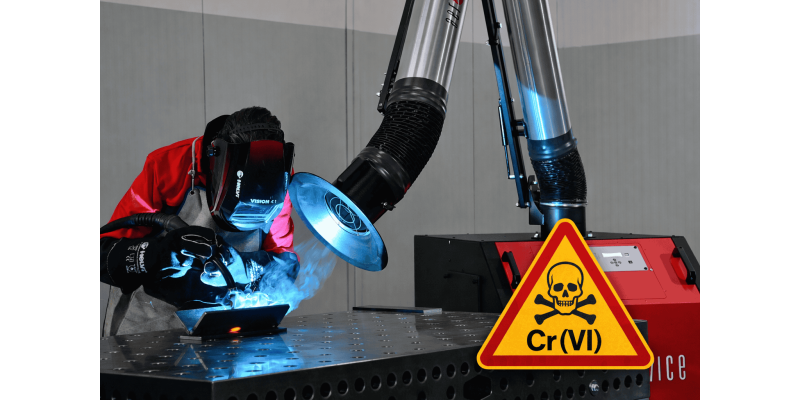
During stainless steel welding, chromium (including hexavalent chromium, Cr(VI)) is primarily present bound to solid particles (metal oxides) within fine and ultrafine particulate aerosols, rather than in gaseous form. This is a key factor when designing effective extraction and filtration systems.
Hexavalent chromium forms when metallic chromium contained in alloys is oxidized at high temperatures during welding processes. This phenomenon is particularly relevant in TIG (Tungsten Inert Gas) welding, but it also occurs in other processes such as MIG/MAG welding, shielded metal arc welding (SMAW/MMA), and plasma cutting.
The main alloys where hexavalent chromium can be generated include:
- Austenitic stainless steels (e.g. AISI 304, 316)
- Ferritic and martensitic stainless steels
- High-chromium alloys (>10.5% chromium content)
- Corrosion- and heat-resistant special alloys
During these processes, high temperatures generate welding fumes composed of ultrafine metal oxide particles. Hexavalent chromium, being highly toxic and classified as a carcinogen, represents a major health risk for operators, especially in cases of prolonged exposure.
Since Cr(VI) is present in particulate form, filtration systems must be specifically designed to capture fine and ultrafine particles. The most effective solutions include local exhaust ventilation (LEV) systems positioned close to the emission source, combined with high-efficiency filters such as HEPA or equivalent.
Another critical aspect is airflow design. Inefficient capture may lead to the dispersion of contaminants into the working environment, increasing exposure risks. Key parameters such as capture velocity, distance from the source, and system configuration must be carefully evaluated.
Implementing advanced hexavalent chromium filtration systems not only protects worker health but also ensures compliance with occupational safety regulations and improves indoor air quality. In today’s industrial landscape, where safety and sustainability are increasingly important, investing in proper extraction and filtration technologies is both a responsible and strategic choice.