
 Deutsch
 Italiano
 English
Introduction
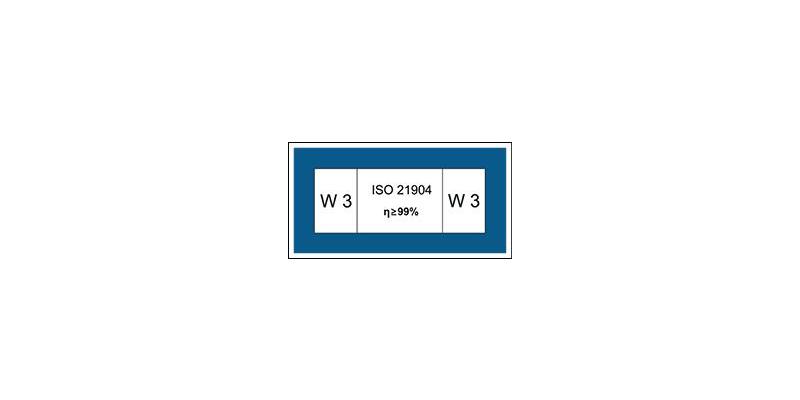
The W3 certification, issued by IFA (Institut für Arbeitsschutz) in Germany, is a quality standard that certifies the efficiency and safety of fume extraction systems designed to handle welding fumes containing high-alloy steels (with over 30% nickel and chrome content). A W3-certified filter unit guarantees that it can capture and retain at least 99% of hazardous particles, protecting both the operator and the surrounding environment.
This certification is essential for companies working with stainless steel welding, as it ensures compliance with European safety regulations and helps reduce legal and health-related risks in the workplace.
What the W3 certification means
W3 defines performance thresholds for the entire extraction chain: capture, filtration, and safe discharge or recirculation. To obtain the IFA certificate, a system must demonstrate verified separation efficiency for ultrafine particulate generated during welding on high-alloy materials. The certificate also validates leak-tight construction, stable airflow, and robust filter loading behavior under realistic operating conditions.
How IFA tests and certifies
During the type test, IFA subjects the filter unit to standardized welding fume aerosols and measures particle concentrations upstream and downstream of the filtration stage. Only equipment achieving ≥99% separation and maintaining safe emission values across the test cycle receives the W3 certification. Documentation includes the device configuration, permissible operating modes (e.g., recirculation vs. exhaust), and maintenance requirements.
Who needs W3
Choose W3-rated fume extraction when:
-
You weld stainless or other high-alloy steels with >30% Ni/Cr.
-
You intend to recirculate filtered air into the workspace.
-
You require demonstrable compliance for audits by HSE/ASL/Env. Health & Safety teams.
For mixed-metal applications, W3 coverage ensures a conservative safety margin.
Key benefits for operations
-
Compliance assurance: A recognized IFA certificate simplifies conformity evidence during inspections.
-
Exposure control: Verified 99% particle retention reduces operator exposure to carcinogenic and sensitizing substances.
-
Process stability: Certified units sustain airflow and capture efficiency as filters load, limiting process variability.
-
Cost control: Efficient recirculation (where permitted) cuts heating/cooling losses versus full exhaust.
Selecting a W3-certified filter unit
Prioritize:
-
Source capture design: High-efficiency hoods, arms, or on-torch extraction to intercept fumes at origin.
-
Filter architecture: Multi-stage media (e.g., spark arrestor + prefilter + high-efficiency main stage) with monitored pressure drop.
-
Verified airflow: Rated m³/h matched to torch/hood geometry and welding current.
-
Monitoring & safety: Differential pressure, airflow supervision, and interlocks to prevent operation outside certified limits.
-
Serviceability: Tool-less access, safe dust handling, and clear maintenance intervals aligned with W3 documentation.
Implementation and maintenance
Maintain capture distances, train operators on correct hood positioning, and log filter changes. Keep the certificate and operating manual accessible. Any modification to ducting, filters, or airflow must respect the certified configuration to preserve W3 status.
Rely on precision-engineered aspiration systems for maximum workplace efficiency
???? Talk to our specialists and get a custom solution today.
Upgrade your extraction system with reliable, compliant technology
???? Schedule a call with our engineering team now.