
 Deutsch
 Francais
 English
Introduction
In industrial settings where flexibility and localized extraction are essential, mobile fume extraction units offer a practical solution for maintaining air quality without the need for permanent installations. However, not all mobile systems are created equal, and understanding their differences is key to making the right choice.
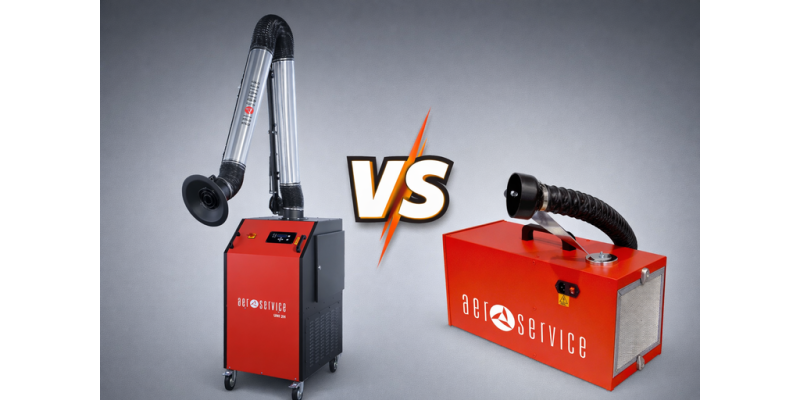
Mobile vs Portable Fume Extraction Units
A common question in industrial air filtration is: what is the difference between a mobile and portable fume extraction unit? Although the terms are sometimes used interchangeably, they refer to distinct categories of equipment with different operational characteristics.
Mobile fume extraction units are typically mounted on wheeled carts and designed to be relocated within a facility. These units are engineered for industrial environments, providing high airflow rates, multi-stage filtration, and compatibility with extraction arms or hoods. They are suited for welding, soldering, laser cutting, and chemical processes where contaminants are generated at specific workstations.
Portable air filtration units, on the other hand, are compact systems designed for easy transport between different sites or rooms. They often prioritize lightweight construction and plug-and-play operation rather than industrial-grade performance. While suitable for temporary applications or smaller-scale processes, they generally offer lower extraction capacity and fewer filtration stages.
Performance and Filtration Efficiency
Mobile fume extraction units are designed for continuous industrial use. They typically include pre-filters, EPA or HEPA filters, and activated carbon filters, enabling the removal of particulate matter, gases, and odors. Their airflow capacity allows effective capture of contaminants at the source.
Portable air filtration units usually rely on simplified filtration configurations and lower airflow rates. This makes them suitable for ambient air purification rather than direct source capture.
Flexibility and Deployment
Mobile units provide operational flexibility within a production environment. They can be positioned near workstations and connected to extraction arms, enabling localized extraction without modifying existing infrastructure.
Portable units are optimized for temporary or decentralized applications, such as maintenance tasks or small workshops. Their portability is an advantage, but it comes with reduced performance and limited customization.
Cost and Industrial Suitability
From a cost perspective, mobile fume extraction units represent a higher initial investment but offer long-term value in industrial environments due to durability, scalability, and compliance with occupational health regulations. Portable units are generally more affordable but may not meet industrial safety requirements for high-emission processes.
Conclusion
Choosing between a mobile and portable air filtration unit depends on application requirements, emission levels, and regulatory constraints. For industrial environments where localized extraction and continuous operation are required, mobile fume extraction units remain the preferred solution. Portable air filtration units can complement these systems in temporary or low-intensity scenarios, but they are not a substitute for industrial-grade extraction solutions.